Build a career in oil & gas exploration and production with Pakistan's top-ranked institute. Internationally recognized diploma covering reservoir engineering, drilling, production, petroleum geosciences, and field economics.
Petroleum engineering is the branch of engineering focused on the exploration, extraction, and production of hydrocarbons (crude oil and natural gas). It integrates reservoir engineering, drilling technology, production systems, and petroleum economics to safely and efficiently develop energy resources. This field is critical to the global economy and offers high-demand, high-reward careers.
"Petroleum engineering drives energy security and economic growth. Skilled petroleum engineers are essential for upstream exploration and downstream operations worldwide."
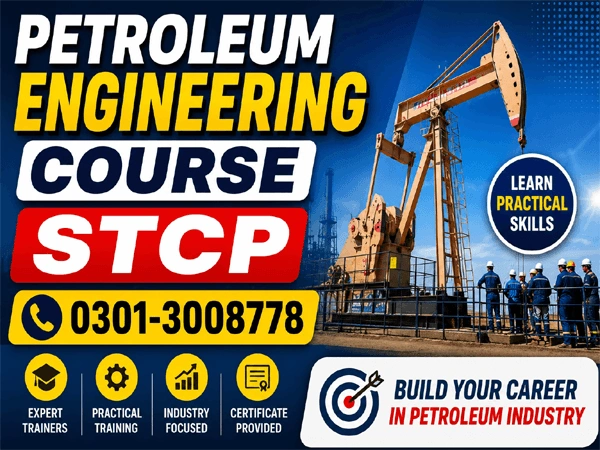
The Petroleum Engineering Diploma at STCP Institute provides a comprehensive foundation in upstream operations. Students learn reservoir characterization, drilling optimization, production facility design, and economic evaluation. The course blends theory with practical case studies and industry-relevant software exposure, preparing graduates for roles in exploration companies, refineries, service providers, and regulatory bodies.
Pakistan has significant hydrocarbon potential, with active exploration in Sindh, Balochistan, and Khyber Pakhtunkhwa. Major companies like OGDCL, PPL, MOL, ENI, and Pakistan Oilfields regularly hire qualified petroleum engineers and technicians. This diploma also opens opportunities in Gulf countries (UAE, Saudi, Kuwait, Oman) where petroleum professionals are highly valued.
Comprehensive coverage of upstream petroleum disciplines, from geology to production and economics.
Petrophysics, fluid properties, reservoir drive mechanisms, volumetric analysis, material balance, and recovery estimation techniques.
Drilling rigs, bit selection, mud systems, casing design, cementing, directional drilling, well completion, and workover operations.
Inflow performance, artificial lift (ESP, rod pump, gas lift), surface facilities, well testing, and production optimization.
Sedimentology, structural geology, seismic interpretation, log analysis, and basin modeling for hydrocarbon exploration.
Separation systems, oil/gas/water treatment, pipelines, pumps, compressors, and storage tank farm operations.
Project economics, risk analysis, production sharing agreements (PSAs), field development planning, and asset management.
Process safety, hazard identification, HAZOP, emergency response, environmental regulations, and carbon management.
Crude oil distillation, cracking, reforming, product blending, and introduction to petrochemical processes.
Upon completing this diploma, you'll be equipped for technical roles in exploration, drilling, production, and refinery operations.
Evaluate hydrocarbon reserves and predict production performance using industry methods.
Design well paths, select drilling fluids, and supervise safe drilling practices.
Implement artificial lift systems and surface facility improvements to maximize recovery.
Conduct economic analysis and risk assessment for oil and gas projects.
Read seismic sections and well logs to identify hydrocarbon-bearing zones.
Qualify for roles like Petroleum Technician, Drilling Supervisor, Production Operator, and HSE Officer.
Ideal for engineering graduates, technicians, and professionals aiming for a career in the oil and gas sector.
Specialize in upstream petroleum operations for industry advancement.
Upgrade technical knowledge for rig-based and field roles.
Boost employability with petroleum specialization.
Transition into energy sector with practical skills.
Petroleum professionals are in high demand in Gulf states.
Understand refining processes and safety protocols.
Contact our admissions team to learn about upcoming batch dates, course fees, and how to register. Seats are limited — apply now and secure your place.